Stabilizers
Stabilizer link guide: selection, failure signs and replacement
EGEROT stabilizers: 110 link codes for Volvo, Mercedes-Benz, Renault Trucks, Scania and more. Select by OE number and size, spot wear, replace safely.
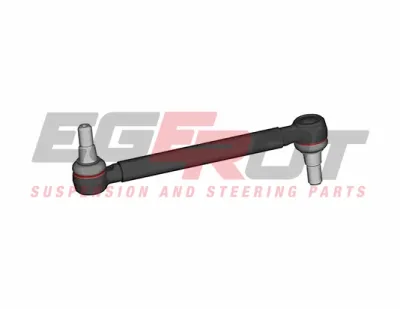
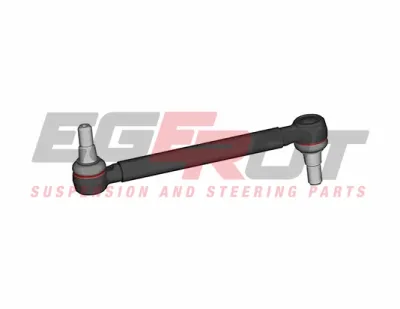
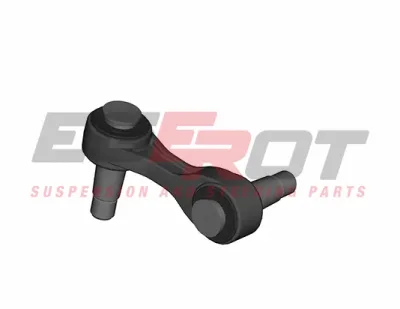
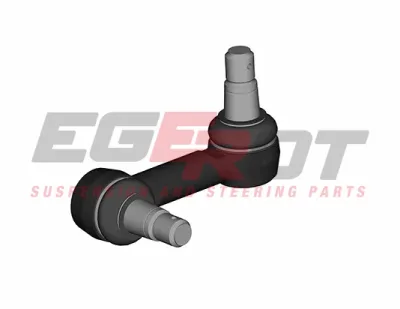
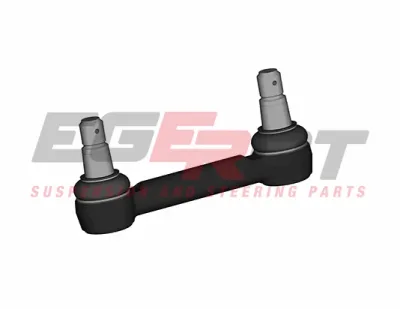
A stabilizer link connects the anti-roll bar to the axle or chassis and usually has a ball joint at one or both ends. Our catalogue lists these parts under stabilizers; they are also known as stabilizer links or anti-roll bar links. They carry the forces of the stabilizer system that limits body roll in corners. Under its EGEROT brand, Özteknik manufactures a stabilizer range of 110 codes for trucks, tractor units and buses from Volvo, Mercedes-Benz, Renault Trucks, Scania, Setra, Iveco and other makes.
What is a stabilizer link and what does it do?
The anti-roll bar is a spring-steel bar that links the left and right sides of an axle and works in torsion. When the vehicle leans outwards in a corner, one side compresses while the other extends; the bar twists, resists this difference and reduces body roll. Stabilizer links connect the ends of the bar to the axle or chassis and transmit the force between them. Their tasks are to:
- limit body and cab roll in corners, on roundabouts and when changing lanes,
- keep the vehicle balanced when a single wheel drops into a pothole or rides over a bump,
- support driving safety and comfort on vehicles carrying loads or passengers,
- follow the suspension movement freely thanks to the ball joint or bush.
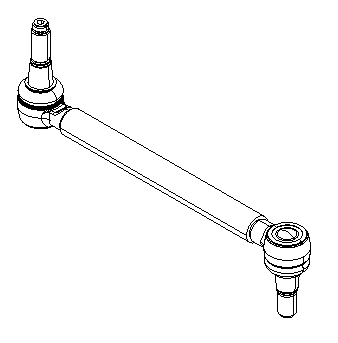
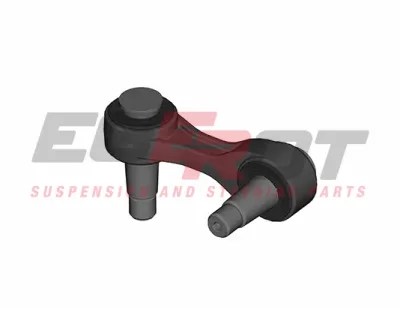
A typical stabilizer link consists of a tubular body with a ball joint at one or both ends; the ball stud is secured by its tapered seat and a nut. On some types one end is an eye with a rubber bush. Links are used on the front and rear axles of trucks and tractor units and on the front and rear suspension of buses and coaches.
How to select a stabilizer link
The most reliable way is the OE number. Enter the number from the old part or the vehicle's parts catalogue in the OE number search and the matching EGEROT code is listed. Sample OE numbers in the range: Volvo 20994418 and 20994419, Mercedes-Benz A 000 320 01 32, A 000 320 02 32 and A 000 320 08 32. One OE number can be linked to more than one code; in that case compare the dimensions.
Besides the OE number, the following details narrow the choice:
- Vehicle make and model: truck, tractor unit or bus; series and chassis type.
- Position: front or rear axle, left or right side.
- Dimensions: length, tube diameter and the cone diameter of the ball stud.
- Connection type: ball joints at both ends or one bushed end; direction of the studs and their angle relative to each other.
Most EGEROT stabilizer codes fall within this range:
| Dimension | Typical range |
|---|---|
| Tube diameter | 28–40 mm |
| Cone diameter (small) | 19.9–28 mm |
| Length | 148–435 mm |
Product pages give the cone as two values, small and large diameter; the range in the table refers to the small diameter. Because the length range is wide, length is the dimension that most clearly separates codes. Before ordering, compare the old part with the values on the product page and always confirm the dimensions.
Failure symptoms
Wear on stabilizer links usually starts at the ball joints:
- Knocking or rattling on rough roads, over speed bumps and when one wheel drops into a pothole
- Noticeably more body or cab roll in corners and on roundabouts
- Sway when changing lanes; the vehicle feels loose and unstable
- Torn ball joint boot, grease loss, ingress of water and dirt
- Play at the ball joint felt by hand or with a pry bar; a loose stud nut
- A bent, damaged or broken link body
- Wear or cracks on the anti-roll bar bushes and mounting brackets
Inspection and replacement
Check stabilizer links at every scheduled service and whenever one of the symptoms above appears:
- Inspect the vehicle on level ground, standing on its wheels with both sides at the same height; if one side is lifted, the link is put under tension and play can be masked.
- Check the ball joint boots for tears, cracks and grease leakage.
- Load the link by hand or with a pry bar and watch for play at the ball joints; make sure the stud nuts are in place and tight.
- Inspect the anti-roll bar bushes, mounting brackets and the bar itself for cracks and bending.
Points to observe during replacement:
- Left and right links work under similar conditions, so if one is badly worn it is advisable to replace both together. Renew worn anti-roll bar bushes at the same time.
- Tapered stud seats must be clean, free of burrs and, unless the manufacturer specifies otherwise, dry. Renew self-locking nuts; if the stud turns with the nut, counter-hold it as specified by the manufacturer.
- Follow the tightening torque and procedure in the vehicle manufacturer's service manual. Complete fitting with the suspension in its normal position and both sides at the same height; otherwise the link remains under tension.
- Replacing a stabilizer link does not normally affect axle alignment; if other suspension or steering parts were replaced at the same time, have the alignment checked.
Safety: stabilizer links directly affect the vehicle's stability in corners and must be fitted by qualified personnel. Never work under a vehicle supported only by a jack; secure it on suitable axle stands.
Production and testing at Özteknik
EGEROT stabilizer links are made in-house at the plant in Kemalpaşa, İzmir, where Özteknik has been manufacturing since 1971. Tube forming, machining of the ball joint housing and stud, heat treatment, welding, surface preparation, ball joint assembly, painting and testing all take place under one roof; details are on the production and R&D page. Tests applied across the EGEROT product line include:
- Torque rod and ball joint fatigue test
- Wear - endurance test
- Rotation torque test
- Ball stud impact test
- Axial movement test
- Dust boot leakage test
Production runs under a quality management system certified to IATF 16949:2016 and ISO 9001:2015; the certificates are on the quality and certificates page. EGEROT stabilizer links are manufactured to OE quality.
Vehicles covered
Volvo has the most codes in the range (FH, FH12, FH16, FM, FM9, FM12, FMX, FL6), followed by Mercedes-Benz, including models such as the 4140, 3340 and 3028. Renault Trucks, Scania, Kässbohrer (Setra), Iveco, Neoplan and DAF are also covered, along with codes for EvoBus, Volkswagen, Leyland DAF and MAN. The Setra, Neoplan and EvoBus codes form the bus side of the range.
Sample products: ER1558 and ER1536 for Volvo, ER1453 for Mercedes-Benz and ER1169 for Setra and Mercedes-Benz buses. All steering and suspension parts of the brand are on the EGEROT page, and every stabilizer link is listed in the stabilizer catalogue.
You can add the codes you need to the quote list or send us your OE numbers via the contact page. OE numbers and brand names are given for comparison purposes only.
Frequently asked questions
How do I find a stabilizer link by OE number?
Enter the OE number from the vehicle's parts catalogue or from the old part into the site search; the matching EGEROT code and its dimensions appear on the product page. If one OE number is linked to several codes, compare length, tube diameter and cone diameter.
Are the left and right stabilizer links the same?
On many vehicles the left and right links are the same part, but some applications use a different length or stud direction depending on position. Check the OE number for each position separately; replacing both sides together is recommended.
What happens if a stabilizer link fails?
Play in the ball joint causes knocking on rough roads, more body roll in corners and a feeling of instability. If a link breaks, the anti-roll bar no longer works on that side, so a worn link should be replaced without delay.
Why does the cone diameter matter?
The ball stud is secured by seating in a tapered bore in the anti-roll bar or bracket; if the cone diameter does not match, the stud cannot seat correctly and the joint is not secure. Compare the small and large cone diameters on the product page with the old part.
Is an axle alignment needed after replacing a stabilizer link?
Replacing a stabilizer link does not normally affect axle alignment. If other suspension or steering parts were replaced at the same time, the alignment should be checked.
Also available in: العربية, Deutsch, Español, Français, Italiano, Русский, Türkçe